
Precautions for Using Cooling Pads in Enclosed Poultry Houses
Publish time:2025-06-27 Column:Tech Features
The cooling of large-scale enclosed poultry houses during summer has always been a persistent concern for farm operators. Failure to create a suitable environment for the flock in a timely manner not only impairs growth performance but also easily triggers health crises such as heat stress, thereby reducing farming profitability. Currently, cooling pads serve as the primary method for summer temperature control in large-scale enclosed poultry houses. This article elaborates on the working principles of cooling pads and outlines key precautions for their use, aiming to provide practical guidance for on-site farming operations.
Ⅰ. Working Principle of Cooling Pads
The core cooling mechanism of cooling pads relies on the heat absorption effect of water evaporation. The main structure consists of porous media made of corrugated fiber paper, which is continuously wetted during operation. When hot, dry air from outside the poultry house passes through the moistened cooling pad, heat from the air is absorbed by the evaporating water. The porous structure of the pad increases the contact area between air and water, accelerating the evaporation process and ultimately delivering cool, moist fresh air to the enclosed poultry house, thereby providing an optimal cooling environment.
The evaporative cooling efficiency of the pad depends on the air velocity passing through it, water temperature, and air humidity. Different pad structural designs require different airflow velocities; generally, a 15 cm thick pad requires an airflow velocity of 2.03 m/s. The water temperature should not be too low, as cold water evaporates less readily, reducing cooling effectiveness. Similarly, if the air humidity is too high, nearing saturation, it becomes difficult for the air to absorb additional moisture, hindering evaporation and compromising cooling performance. It is recommended to activate the cooling pads at temperatures above 27°C, with adjustments possible based on the growth stage of the flock or specific on-site conditions.
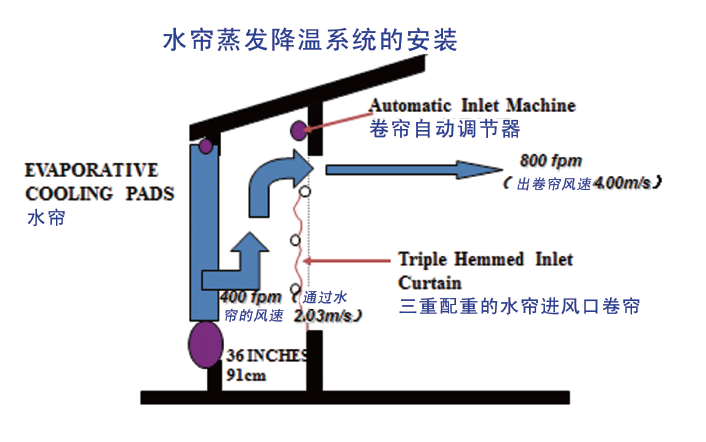
Installation of Evaporative Cooling Pad Systems
II. Precautions for Cooling Pad Operation
01. Match the cooling pad area to the number of exhaust fans
If the cooling pad area is too small, the airflow velocity through the pads will be too high, causing water to detach from the pad surface and enter the poultry house directly. This results in poor cooling performance, increased indoor humidity, and wet floors near the pads. Conversely, if the pad area is too large, the airflow velocity will be too low, reducing friction between air and the pad surface, slowing evaporation, and diminishing the cooling effect.
Calculation method for cooling pad area:
Total ventilation volume of the house = Number of fans × Rated airflow per fan under working pressure
Cooling pad area = Total ventilation volume ÷ Airflow velocity through the pad
02. Avoid obstructing the surface of the cooling pads
Blockages reduce the effective working area, increasing the airflow velocity through the remaining open sections.
03. Use cooling pads only when indoor humidity is below 70%
Operating the cooling pump when indoor humidity is already high can lead to elevated temperature and humidity levels inside the house, increasing the perceived temperature for the flock.
04. Follow the "gradually dry, gradually wet" principle for water supply timing
After the entire surface of the cooling pads is wet, turn off the water pump. Allow the pads to dry completely before restarting the pump. This cycle ensures the pads alternate between wet and dry states, optimizing water evaporation from the pad surface.
05. Avoid using cold water for cooling pads
The cooling principle relies on water evaporation. Since cold water evaporates more slowly, it is not suitable for use in cooling pads.
06. Regularly disinfect the water used in cooling pads
It is recommended to use disinfectants with low irritancy, such as potassium peroxymonosulfate composite. Regularly clean, disinfect, or replace filter elements. Strong acids or alkalis are strictly prohibited.
07. Clean the cooling pads regularly
Prevent dust accumulation on the pads. Excessive dirt on the pad surface hinders water evaporation and reduces cooling efficiency.